HVAC Installation For Builders Around Ville Platte
You're building homes in Acadiana, and you need an HVAC contractor who understands construction schedules, shows up when they say they will, and installs systems that won't cause callbacks. That's why you want Smith Air Conditioning. We've been working with builders around Ville Platte for over 50 years, installing systems in new construction from single custom homes to entire subdivisions. We handle everything from initial design and load calculations through rough-in, final installation, and startup.
Give us a call at 337-363-1866 or reach out online to discuss your next project.
What's The Cost Per Square Foot For New Construction HVAC?
Budgeting HVAC accurately helps you bid projects competitively while maintaining margins. Here's what drives costs in Louisiana's new construction.
- Residential New Construction Runs $1.75-$2.50 Per Square Foot: This covers equipment, ductwork, installation labor, and startup for a standard-efficiency forced air system. A 2,000 square foot home typically falls in the $3,500-$5,000 range for HVAC installation when walls are still open, and access is easy.
- Higher Efficiency Systems Add Cost: Minimum SEER2 in Louisiana is 15, and that's your baseline cost. Jump to 16-18 SEER2 and add $500-$1,500 to the job. High-efficiency variable-speed systems with 20+ SEER2 ratings can add $2,000-$3,000 but help homes meet energy code requirements and appeal to buyers.
- Complex Layouts Increase Labor: Multi-story homes, vaulted ceilings, complicated duct runs, and tight attic spaces all add installation time. A straightforward ranch-style home costs less to install than a two-story home with bonus rooms and multiple zones. We price these accurately after reviewing plans.
- Louisiana Climate Affects Equipment Sizing: AC loads down here are higher than in northern states due to our extended cooling season and humidity. Proper sizing requires Manual J calculations, not guesswork, but you can generally budget for slightly larger equipment capacity than homes up north.
- Ductwork Quality Matters For Code Compliance: Louisiana energy code requires proper duct sealing and testing. Cheap flex duct installations that leak like sieves won't pass inspection. We install ductwork that meets code the first time, which costs slightly more than hack work but saves you from failed inspections.
Need pricing for your specific project? Call 337-363-1866 and send us the plans.
When Should HVAC Be Installed During Construction?
Timing HVAC installation properly keeps your project on schedule and prevents conflicts with other trades. Here's how we coordinate with your build timeline.
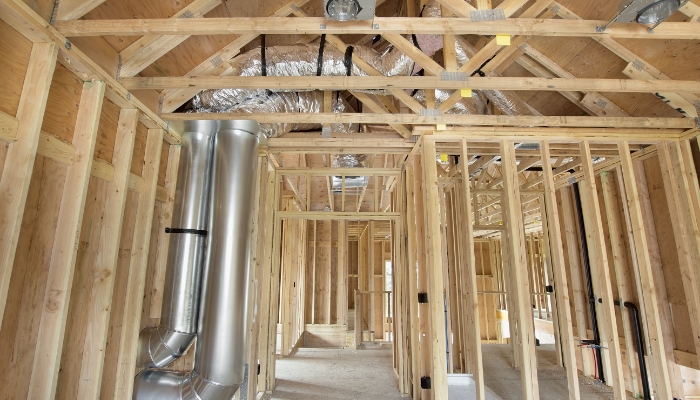
- Rough-In Happens After Framing, Before Drywall: We install ductwork, refrigerant lines, and drain lines during the rough-in phase when walls are still open. This typically happens after framing inspection and before insulation goes in. Coordinating with your electrician and plumber during rough-in prevents conflicts over chase space.
- Equipment Sits On Pads Or Gets Mounted After Exterior Work: Outdoor condensers go on pads we pour or mount on brackets after siding and exterior work is substantially complete. We don't set expensive equipment on site until there's less risk of damage from other trades working around it.
- Final Installation Happens Near Completion: We come back to set air handlers or furnaces, make final connections, charge refrigerant, and start up the system once drywall's finished and the house is substantially enclosed. This usually happens just before the final mechanical inspection.
- Startup Testing Requires Power & Finished Work: We can't fully test and balance the system until electrical service is live and registers are installed. We coordinate this timing with your inspection schedule to make sure everything's operational for the final mechanical sign-off.
- Lead Time On Equipment Matters: Standard equipment ships in one to two weeks, typically, but high-efficiency models or specific brands can take longer. Give us plans early enough that equipment delays don't hold up your schedule.
Questions about coordinating HVAC timing with your build? Call 337-363-1866 , and we'll walk through the schedule.
New Construction HVAC FAQs
Minimum code in Louisiana requires 15 SEER2 for AC. That's your baseline. For spec homes, 15-16 SEER 2 hits the price point most buyers expect. For custom builds or energy-efficient homes, 16-18 SEER 2 offers better performance without extreme cost. Above 18 SEER2, you're in premium territory that adds significant cost but appeals to efficiency-focused buyers and helps meet tough energy targets.
Rough-in for a typical single-family home takes one to two days, depending on complexity. Final installation takes another day once the house is ready. For subdivisions, we schedule multiple crews to handle volume efficiently without slowing your closings. Lead time on equipment typically runs one to three weeks, so bring us in early enough that equipment delivery doesn't delay your schedule.
Find contractors who show up reliably, coordinate well with other trades, and do quality work that passes inspection the first time. Check their license, insurance, and track record with local inspectors. Ask if they do Manual J calculations or just guess at sizing. Find out what brands they install and whether they have factory training. Most importantly, talk to other builders they work with regularly about reliability and quality.
What Size System Does Each Home Actually Need?
Proper sizing prevents callbacks, keeps homes comfortable, and helps pass inspections. Here's why we don't guess at equipment capacity.
- We Run Manual J Load Calculations On Every Home: This industry-standard calculation accounts for square footage, insulation levels, window placement, orientation, ceiling heights, and Louisiana climate data. It tells us exactly what capacity each house needs rather than using outdated rules of thumb.
- Floor Plans Alone Don't Give Accurate Sizing: Two identical floor plans can need different equipment capacities depending on insulation package, window specs, and site orientation. We need actual specs to size correctly, not just square footage from the plans.
- Oversized Systems Cause Humidity Problems: This is huge in Louisiana. Oversized AC runs short cycles, never removes humidity properly, and creates that clammy feeling even when the thermostat says 72. Proper sizing ensures equipment runs long enough each cycle to dehumidify effectively.
- Undersized Systems Can't Keep Up: On the flip side, undersizing means homes don't cool adequately on hot days, and equipment runs constantly trying to catch up. This kills efficiency, shortens equipment life, and generates unhappy homeowners calling you with complaints.
- We Coordinate Sizing With Your Energy Package: If you're building to specific energy efficiency standards or targeting HERS ratings, we size equipment to work with your insulation and air sealing package. This ensures the whole home performs as designed rather than having one component working against the others.
Need load calculations for your project? Call 337-363-1866 and send us the specs.
How Do You Choose Between System Types For New Construction?
Different system types fit different projects and price points. Here's how we guide builders through equipment decisions.
- Forced Air With Gas Or Electric Heat Dominates: Most Ville Platte new construction uses central AC with either a gas furnace or an electric air handler. This offers good performance at a competitive installed cost, and buyers understand how it works. It's the safe, proven choice for spec homes.
- Heat Pumps Make Sense In Louisiana Climate: Heat pumps heat and cool efficiently in mild climates, and Louisiana winters rarely get cold enough to challenge modern heat pump performance. They cost slightly less than a separate AC and gas furnace, offer good efficiency, and work well for energy-conscious buyers.
- Multi-Zone Systems Fit Larger Or Complex Homes: Two-story homes often benefit from zoning to handle different loads upstairs versus downstairs. This costs more upfront but provides better comfort and can be a selling point for larger homes where single-zone systems struggle.
- Mini-Splits Work For Specific Applications: We install mini-splits for bonus rooms over garages, detached guest quarters, or situations where running ductwork isn't practical. They're more expensive per-room than adding to central ductwork, but solve problems where ducted systems won't work.
- Equipment Brand Affects Warranty & Support: We install Lennox, Carrier, and Trane because they're proven brands with good warranty support and available parts. Choosing off-brand equipment to save a few hundred dollars often costs more long-term when warranties are weak and parts are scarce.
Not sure what system type fits your project? Call 337-363-1866 , and we'll discuss options.
Partner With Ville Platte's Builder-Focused HVAC Team
After more than 60 years of installing HVAC systems in new construction throughout Acadiana, Smith Air Conditioning has become a trusted partner not only in Ville Platte but across Eunice, Opelousas, Sunset, Carencro, and Lafayette as well. We work with custom home builders, production builders, and developers who need accurate bids, dependable scheduling, and installations that pass inspection the first time. Whether it's single-family builds in growing Carencro neighborhoods or subdivision projects in Lafayette or Opelousas, we keep HVAC work aligned with construction timelines.
Need our Expertise Today? Give us a call 337-363-1866 or contact us online to schedule a consultation!